U.S. Citizenship & Naturalization Lawyers in Austin, TX
Taking the Final Step to U.S. Citizenship with Confidence
Becoming a naturalized citizen of the United States is one of the most significant milestones in your immigration journey. U.S. citizenship provides enduring legal protections, greater peace of mind, and full participation in American civic life. As a citizen, you gain the right to vote in federal elections, sponsor eligible family members for permanent residence with higher priority, travel with a U.S. passport, access federal employment opportunities, and build a lasting future free from the routine immigration restrictions and deportation risks faced by noncitizens.
However, applying for naturalization is much more than filling out a form. When you submit Form N-400 (Application for Naturalization), United States Citizenship and Immigration Services (USCIS) re-examines your entire immigration history. Prior travel outside the country, minor criminal arrests, unpaid taxes, delinquent child support, or inconsistencies on past Green Card applications can unexpectedly put your status at risk.
At Ponce Law Firm, PLLC., we ensure your transition to U.S. citizenship is smooth, thorough, and legally secure. Led by Lead Attorney Griselda Ponce—an experienced trial advocate admitted to the State Bar of Texas and the U.S. Court of Appeals for the Fifth Circuit—our firm provides candid, strategic representation for clients across Austin, Central Texas, and worldwide. We conduct comprehensive background audits before filing to address potential risks, thoroughly prepare you for your interview and civics exam, and stand by your side every step of the way.
Comprehensive Naturalization & Citizenship Services
Under the Immigration and Nationality Act (INA § 316 and § 319), Lawful Permanent Residents (LPRs) who satisfy specific statutory requirements may apply to become naturalized U.S. citizens. Our firm guides clients through every phase of the citizenship process, ensuring every requirement is documented and verified.
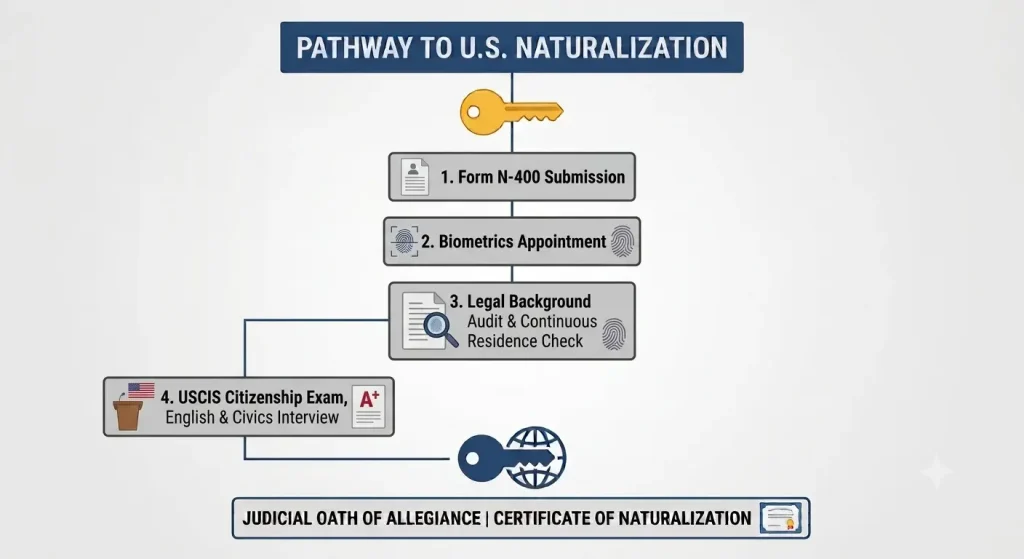
Key Statutory Requirements for Form N-400 Naturalization
To successfully naturalize, an applicant must satisfy several statutory criteria established by federal law:
1. Statutory Residence Window (5-Year vs. 3-Year Rule)
- The 5-Year General Rule (INA § 316): Most permanent residents must hold a valid Green Card for at least 5 years before applying for naturalization.
- The 3-Year Marriage Exemption (INA § 319): Applicants who have been Lawful Permanent Residents for at least 3 years may file if they have been continuously married to and living in marital union with a U.S. citizen spouse for the entire three-year period.
- Early Filing Window: Applicants may submit Form N-400 up to 90 days before reaching their 3-year or 5-year anniversary as permanent residents.
2. Continuous Residence & Physical Presence
- Continuous Residence: You must demonstrate that you have maintained continuous residence in the U.S. during the required statutory period (3 or 5 years). Trips abroad lasting more than 180 days (6 months) break continuous residence unless proven otherwise. Absences of 1 year or more automatically break continuity unless an advance application to preserve residence (Form N-470) was approved.
- Physical Presence: You must prove that you were physically present inside the United States for at least 30 months out of the 5 years (or 18 months out of the 3 years) immediately preceding your application date.
- Local Jurisdiction Residence: You must have resided for at least 3 months within the state or USCIS service district (such as the USCIS San Antonio or Austin district) where you submit your application.
3. Good Moral Character (GMC)
Applicants must prove they have been individuals of Good Moral Character during the statutory period (and up to the moment of taking the Oath of Allegiance). Factors that can undermine or destroy Good Moral Character include:
- Arrests, charges, or convictions for crimes involving moral turpitude (CIMT) or drug offenses.
- DUI / DWI convictions or multiple alcohol-related offenses.
- Failure to pay federal, state, or local taxes.
- Delinquency in court-ordered child support or spousal maintenance payments.
- Providing false or misleading information on any immigration document or to an immigration officer.
- Voting illegally or falsely claiming U.S. citizenship.
4. English Literacy & U.S. Civics Competence
Applicants must demonstrate basic ability to read, write, speak, and understand the English language, as well as pass an oral test on U.S. history and government (civics).
Exemptions, Special Accommodations & Medical Waivers
Federal law provides specific exemptions for older applicants and individuals with medical conditions that affect learning or memory:
Age and Length of Permanent Residency Exceptions (Language Exemptions)
While all applicants must take the civics exam, older long-term residents may take the civics test in their native language with an interpreter:
- 50/20 Exemption: If you are 50 years of age or older and have lived in the U.S. as a Lawful Permanent Resident for at least 20 years, you are exempt from the English language requirement.
- 55/15 Exemption: If you are 55 years of age or older and have lived as a permanent resident for at least 15 years, you are exempt from the English language requirement.
- 65/20 Special Civics Exemption: If you are 65 years of age or older and have been a permanent resident for at least 20 years, you may take a simplified, 10-question version of the civics exam in your primary language.
Form N-648: Medical Disability Exception
Applicants who are unable to meet the English or civics requirements due to a physical or developmental disability or mental impairment lasting (or expected to last) at least 12 months may submit Form N-648, Medical Certification for Disability Exceptions.
Form N-648 must be completed and certified by a licensed medical doctor, doctor of osteopathy, or clinical psychologist. The certification must detail how the medical condition directly prevents the applicant from learning or demonstrating English or civics knowledge. Ponce Law Firm, PLLC., works closely with your medical providers to ensure Form N-648 meets USCIS evidentiary standards.
The Critical Risk: Auditing Your Immigration History Before Filing
Filing Form N-400 opens your complete immigration history to USCIS scrutiny. The adjudicating officer will re-examine how you originally obtained your Green Card and verify whether you were lawfully admitted to permanent residence.
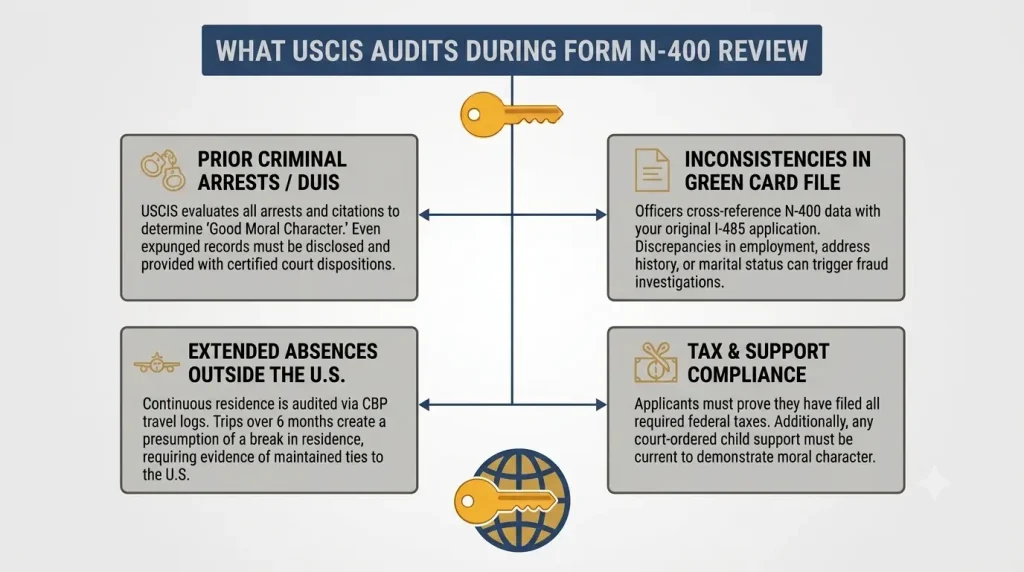
Common Red Flags That Threaten Naturalization Applications:
- Undisclosed Arrests or Criminal Charges: Even arrests that were dismissed, expunged, or dropped must be disclosed on Form N-400. Hiding an arrest can be classified as misrepresentation, leading to an immediate denial and potential removal proceedings.
- Errors or Inconsistencies in Previous Filings: Discrepancies regarding work history, previous marriages, addresses, or prior entries into the U.S. between your initial Green Card application (Form I-485 or DS-260) and Form N-400 will raise red flags.
- Selective Service Registration Compliance: Male permanent residents between the ages of 18 and 25 must register with the Selective Service System. Failure to register can result in denial based on Good Moral Character unless you can prove the failure was not knowing or willful.
- Extended Absences Abroad: Staying outside the United States for prolonged periods can cause USCIS to claim you abandoned your permanent resident status.
- Tax Delinquencies: Owing back taxes without an active, compliant payment plan with the IRS or state tax authority will result in denial under the Good Moral Character requirement.
Do not submit Form N-400 without a complete legal review if you have any criminal history, tax debt, extended international travel, or discrepancies in your past applications! Ponce Law Firm, PLLC., conducts thorough Freedom of Information Act (FOIA) background checks when needed to ensure your application is safe to proceed.
Naturalization Requirements at a Glance
| Standard / Criteria | 5-Year General Rule (INA § 316) | 3-Year Marriage Exemption Rule (INA § 319) | Disability Exemption (Form N-648) |
|---|---|---|---|
| Permanent Residency Duration | Minimum 5 years as an LPR | Minimum 3 years as an LPR | Meets applicable 3-year or 5-year LPR standard |
| Marital Status Requirement | None | Married & living in marital union with U.S. citizen | Dependent on statutory basis |
| Physical Presence Required | 30 months (913 days) in the U.S. | 18 months (548 days) in the U.S. | Standard requirements apply |
| Language & Civics Exam | Standard English & Civics test | Standard English & Civics test | Waived upon approved N-648 certification |
| Early Filing Window | 90 days before 5th anniversary | 90 days before 3rd anniversary | 90 days before anniversary |
Why Choose Ponce Law Firm, PLLC for Your Naturalization Journey?
When finalizing your journey toward U.S. citizenship, you need an experienced legal team that pays attention to detail and protects your rights.
- Two Decades of Proven Legal Practice: Lead Attorney Griselda Ponce has practiced immigration law for over 20 years, guiding thousands of individuals and families to permanent residency and citizenship.
- Federal Appellate Court Experience: Admitted to practice before the U.S. Court of Appeals for the Fifth Circuit, Attorney Ponce brings deep trial and litigation experience to every case.
- Thorough Risk Assessment: We don’t just fill out forms; we audit your entire immigration file, travel history, criminal records, and tax filings to eliminate surprises before your interview.
- Complete Interview Preparation: We conduct mock interviews, review civics questions, and prepare you for officer interactions so you feel completely confident.
- Fully Bilingual Services: Our legal team provides clear, seamless representation in both English and Spanish.