
Reuniting Families with Care, Clarity, and Courage
Navigating the United States immigration system to bring a family member to the U.S. or secure permanent residency for a spouse, child, or parent is one of the most important legal journeys your family will ever undertake. However, complex immigration laws, bureaucratic red tape, shifting government policies, and processing delays can make the process overwhelming. One minor error on an application or an oversight during an interview can result in months of delay, costly denials, or unwanted government scrutiny.
At Ponce Law Firm, PLLC., we understand the stress and uncertainty you face. Led by Attorney Griselda Ponce—an experienced trial advocate admitted to the State Bar of Texas and the U.S. Court of Appeals for the Fifth Circuit—our legal team provides straightforward, client-centered representation tailored to your family’s unique situation. Based in Austin, Texas, and serving clients across Texas, nationwide, and around the world, we take on complex family immigration cases that other attorneys avoid.
Whether you are petitioning for a relative, applying for Adjustment of Status inside the U.S., processing an immigrant visa through an overseas embassy, or renewing your Green Card, we fight to protect your family’s future and keep you together.
Complete Family & Permanent Residency Services
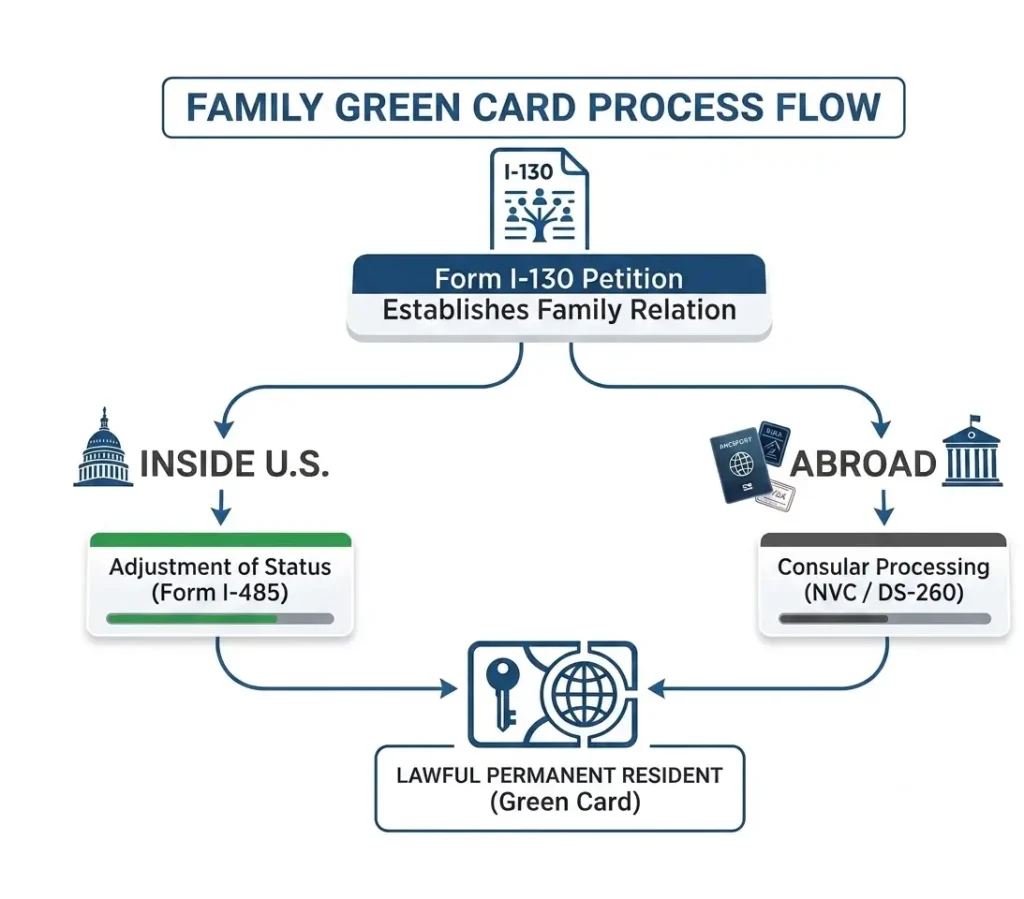
Under the Immigration and Nationality Act (INA), U.S. citizens and Lawful Permanent Residents (LPRs) have the legal right to sponsor certain family members for permanent residency. Depending on where your relative is currently living and how they entered the United States, their pathway to a Green Card will follow one of two major legal routes: Adjustment of Status (AOS) inside the U.S. or Consular Processing (CP) abroad.
Our firm manages every stage of the family immigration timeline, ensuring your petitions are backed by primary civil records, financial proof, and evidentiary documentation.
Form I-130: Petition for Alien Relative
The foundation of every family-based Green Card case is Form I-130, Petition for Alien Relative. Filed with U.S. Citizenship and Immigration Services (USCIS), this petition establishes that a valid, qualifying family relationship exists between a U.S. sponsor and a foreign national relative.
Understanding Sponsoring Categories
Federal immigration law divides family sponsorship into two main preference groups:
- Immediate Relatives of U.S. Citizens:
⚬ Spouses of U.S. citizens.
⚬ Unmarried minor children (under 21 years old) of U.S. citizens.
⚬ Parents of U.S. citizens (provided the citizen sponsor is at least 21 years old).
⚬ Advantage: Immediate Relatives are exempt from annual visa quotas, meaning immigrant visas are immediately available without long waiting lists. - Family Preference Categories:
⚬ F1: Unmarried adult sons and daughters (21 or older) of U.S. citizens.
⚬ F2A: Spouses and unmarried minor children of Lawful Permanent Residents.
⚬ F2B: Unmarried adult sons and daughters of Lawful Permanent Residents.
⚬ F3: Married sons and daughters of U.S. citizens.
⚬ F4: Brothers and sisters of U.S. citizens (provided the citizen sponsor is at least 21).
⚬ Note: Preference categories are subject to annual statutory limits and priority date waiting periods maintained in the Department of State’s Visa Bulletin.
Marriage-Based Green Cards & Proving Bona Fide Marriage
When petitioning for a spouse, USCIS subjects the marriage to strict examination to prevent immigration fraud. You must prove not only that your marriage is legally valid, but that it is bona fide—meaning entered into in good faith based on a shared life together.
Ponce Law Firm, PLLC, helps couples compile compelling evidentiary packages, including joint financial accounts, lease agreements, joint tax returns, co-ownership of assets, photo histories, and sworn witness affidavits. We prepare you thoroughly for the USCIS marriage interview so you can present your relationship with confidence.
Adjustment of Status (AOS – Form I-485)
If your foreign national family member is already physically present within the United States, they may be eligible to obtain their Green Card without leaving the country through Adjustment of Status (Form I-485) pursuant to INA § 245(a).
Eligibility for Domestic Adjustment
To adjust status inside the U.S., an applicant generally must satisfy the following core requirements:
- Lawful Entry or Inspection: The applicant entered the U.S. legally following inspection and admission or parole by an immigration officer.
- Immediate Visa Availability: An immigrant visa must be immediately available (always true for Immediate Relatives of U.S. citizens).
- Admissibility: The applicant must not be barred by statutory grounds of inadmissibility, such as specific criminal convictions, prior fraud, or immigration violations (unless an inadmissibility waiver is granted).
The Concurrent Filing Advantage
For Immediate Relatives residing in the U.S. who entered lawfully, we can file the Form I-130 petition and Form I-485 Adjustment of Status application concurrently. Along with these core forms, we file:
- Form I-765 (Application for Employment Authorization): Allows the applicant to receive an interim work permit while their Green Card is pending.
- Form I-131 (Application for Travel Document): Provides Advance Parole, permitting legal international travel in qualifying cases while the application is under review.
- Form I-864 (Affidavit of Support): Demonstrates that the sponsor meets federal income guidelines to prevent the applicant from becoming a public charge.
- Form I-693 (Report of Immigration Medical Examination): Completed by an authorized civil surgeon to confirm health clearance.
If an applicant entered the U.S. without inspection, domestic adjustment may still be possible through special statutory provisions such as INA § 245(i) (for petitions filed on or before April 30, 2001) or through humanitarian programs such as VAWA, U Visas, or Military Parole in Place. If these exemptions do not apply, we help clients evaluate provisional unlawful presence waivers (Form I-601A) prior to consular processing.
Consular Processing (CP) for Overseas Relatives
When a foreign relative resides outside the United States, or is ineligible to adjust status domestically, they must complete their immigrant visa application through Consular Processing.
Step-by-Step Consular Process
- USCIS Petition Approval: First, Ponce Law Firm, PLLC, files Form I-130 with USCIS. Once approved, USCIS transfers the case file to the Department of State’s National Visa Center (NVC).
- NVC Document Pre-Screening: Once a visa number becomes available, we pay the required fees, complete the online Form DS-260 (Immigrant Visa Application), and upload required civil documents and Affidavit of Support records to the NVC portal.
- Consular Interview: After the NVC determines the file is documentarily complete, the case is scheduled for an in-person immigrant visa interview at the designated U.S. Embassy or Consulate in the applicant’s home country.
- Visa Issuance & Entry: Upon successful completion of the interview and medical exam, the immigrant visa is stamped in the applicant’s passport. Once they enter the U.S., they are admitted as a Lawful Permanent Resident, and their physical Green Card is mailed to their U.S. address.
Consular Processing requires precision. Omitted documents or misunderstandings at the embassy interview can cause delays under INA § 221(g) or result in visa refusals. Our team guides you through every document submission and prepares you for consular questioning.
Form I-90: Green Card Renewal and Replacement
Maintaining an unexpired Permanent Resident Card is a statutory requirement under federal law (8 C.F.R. § 264.5). Lawful Permanent Residents must submit Form I-90 to:
- Renew a 10-year Green Card that has expired or will expire within six months.
- Replace a lost, stolen, mutilated, or destroyed Green Card.
- Correct incorrect legal details or administrative errors made by USCIS.
- Update legal name or personal information following marriage or court order.
A Critical Warning Before Filing Form I-90
Many permanent residents assume that filing Form I-90 is a routine administrative task. However, submitting Form I-90 triggers new criminal background checks with the FBI and DHS.
If you have been arrested, charged with a crime, convicted of an offense, or spent extended periods of time living outside the U.S. since receiving your Green Card, filing Form I-90 could alert immigration authorities to potential grounds of deportability. Do not file Form I-90 without consulting an experienced immigration lawyer if you have any criminal history or long international travel periods. Ponce Law Firm, PLLC conducts background reviews before filing to protect your permanent legal status.
Family & Permanent Residency Pathways at a Glance
| Service & Form | Target Applicant | Primary Eligibility Requirement | Strategic Focus & Processing Goal |
|---|---|---|---|
| Form I-130 (Petition for Relative) | Spouses, children, parents, siblings of U.S. citizens/LPRs | Qualifying blood or marital relationship; lawful sponsor status | Establish legal relationship; secure priority date |
| Form I-485 (Adjustment of Status) | Relatives physically present inside the United States | Lawful entry/inspection or statutory exemption; available visa | Concurrent filing; obtain work permit & Green Card without leaving U.S. |
| Consular Processing (DS-260) | Relatives living abroad or ineligible for domestic AOS | Approved I-130 petition; document qualification at NVC | Secure immigrant visa through foreign U.S. Consulate |
| Form I-90 (Renewal/Replacement) | Existing Lawful Permanent Residents (10-Year Card Holders) | Current LPR status; card expired, lost, or damaged | Renew legal proof of status; review criminal/travel history before filing |
Why Choose Ponce Law Firm, PLLC for Your Family’s Case?
When your family’s future and freedom in the United States are on the line, you need legal representation that combines trial experience with personalized care.
- Decades of Proven Experience: Lead Attorney Griselda Ponce brings more than 20 years of litigation experience in complex immigration matters, having fought cases before USCIS, Immigration Courts (EOIR), and federal courts.
- National & Global Reach: Immigration law is federal. Based in Austin, Texas, our firm represents clients across Texas, throughout all 50 states, and worldwide.
- Bilingual Legal Team: We deliver complete legal representation in both English and Spanish, ensuring clear communication without language barriers.
- Candid, Straightforward Advocacy: We do not beat around the bush. We analyze your case, explain your legal options clearly, and tell you exactly what to expect so there are no surprises.
- A Record of Fighting for Families: Attorney Ponce’s federal court testimony regarding family detention conditions established landmark standards for the protection of immigrant mothers and children nationwide. We bring that same commitment to every client we serve.