

Opens in a new tab
Current Situation

The following questions are optional

Disclaimer & Privacy Notice

Discreet & Secure Consultation Request: We treat your inquiry with strict privacy and professional discretion. Provide your basic details, and our legal team will contact you securely to discuss your case. Disclaimer & Privacy Notice: Submitting this form does not create an attorney-client relationship. While we maintain strict privacy regarding all inquiries and will never sell or share your data, please do not submit sensitive case documents or time-sensitive details through this web form. Full case evaluation and confidential document review take place during your private consultation. You may opt out of communications at any time.

Google reCaptcha: Invalid site key.

Ponce Law Firm
Schedule Now
1212 E. Braker Ln
Austin, TX 78753
1212 E. Braker Ln, Austin, TX 78753
Ponce Law Firm, PLLC | Immigration & Naturalization
Proudly serving the immigrant community in Texas.

Deportation & Removal Defense

Current Situation

The following questions are optional

Discreet & Secure Consultation Request: We treat your inquiry with strict privacy and professional discretion. Provide your basic details, and our legal team will contact you securely to discuss your case. Disclaimer & Privacy Notice: Submitting this form does not create an attorney-client relationship. While we maintain strict privacy regarding all inquiries and will never sell or share your data, please do not submit sensitive case documents or time-sensitive details through this web form. Full case evaluation and confidential document review take place during your private consultation. You may opt out of communications at any time.

Google reCaptcha: Invalid site key.

Removal Defense & EOIR Immigration Court Lawyers in Austin, TX

Fighting to Protect Your Family, Freedom, and Right to Remain in the U.S.

Receiving a Notice to Appear (NTA) in Immigration Court or discovering that a loved one has been detained by Immigration and Customs Enforcement (ICE) is one of the most frightening experiences a family can face. The Executive Office for Immigration Review (EOIR) process is complex, high-stakes, and unyielding. One procedural error, missed deadline, or ineffective hearing can result in a final order of removal and separation from your home and family. At Ponce Law Firm, PLLC, we do not run from tough courtroom fights. Led by Lead Attorney Griselda Ponce—an experienced trial advocate licensed in Texas since 2004 and admitted to practice before the U.S. Court of Appeals for the Fifth Circuit—our firm specializes in complex removal defense and litigation. Based in Austin, Texas, and representing clients in Immigration Courts across Texas and nationwide, we bring a tough, candid, and direct legal defense to every case.

We do not make false promises or beat around the bush. We analyze the government’s charges, identify every available defense under federal law, challenge procedural defects, and aggressively advocate for your right to remain in the United States.

Overview of Removal Defenses & EOIR Court Motions

Relief / Motion CategoryPrimary Statutory Form / ToolLegal Standard & Primary PurposeKey Eligibility Considerations
Cancellation of Removal (42B)Form EOIR-42BNon-permanent resident defense against deportation10 years continuous presence, good moral character, exceptional & extremely unusual hardship to qualifying U.S. citizen/LPR relative
Asylum, Withholding & CATForm I-589Protection based on fear of persecution or torture in home countryPast persecution or well-founded fear based on race, religion, nationality, PSG, or political opinion; 1-year deadline exceptions
Adjustment of Status in CourtForm I-485Securing permanent residency directly before an Immigration JudgeApproved underlying petition (I-130/I-360) and immediately available immigrant visa
Motion to Terminate (MTT)Written EOIR MotionDismissing removal proceedings due to defective charges or NTAInvalid Notice to Appear, lack of alienage proof, or statutory grounds not met
Change of Venue (COV)Written EOIR MotionTransferring case to a new Immigration Court locationProof of new permanent residence and geographic convenience
Motion to RecalendarWritten EOIR MotionRestoring an administratively closed case to the active docketApproved affirmative petition (e.g., U Visa or waiver) ready for final court review

Key Substantive Defenses Against Removal

When placed in removal proceedings, noncitizens have the constitutional right to due process and the opportunity to apply for statutory forms of relief under the Immigration and Nationality Act (INA).

1. Cancellation of Removal for Non-Permanent Residents (Form EOIR-42B)

Cancellation of Removal is one of the most powerful defenses available to non-permanent residents who are facing deportation. If granted by an Immigration Judge, the removal proceedings are terminated, and the respondent is granted Lawful Permanent Resident (Green Card) status.

Statutory Requirements under INA § 240A(b):

To qualify for 42B Cancellation of Removal, an applicant must satisfy four strict statutory criteria:

  1. 10 Years of Continuous Physical Presence: You must prove continuous physical presence in the United States for at least 10 years immediately preceding the service of the Notice to Appear (NTA) or the commission of a disqualifying offense (known as the “stop-time rule”).
  2. Good Moral Character (GMC): You must demonstrate good moral character throughout the entire 10-year period.
  3. No Disqualifying Criminal Convictions: You must not have been convicted of an offense under INA § 212(a)(2), 237(a)(2), or 237(a)(3) (such as crimes involving moral turpitude, drug offenses, or aggravated felonies).
  4. Exceptional and Extremely Unusual Hardship: You must establish that your removal would result in exceptional and extremely unusual hardship to your qualifying U.S. citizen or Lawful Permanent Resident spouse, parent, or child.

Proving “exceptional and extremely unusual hardship” requires establishing that the hardship to your qualifying family member goes far beyond the normal distress associated with deportation. Ponce Law Firm, PLLC builds exhaustive evidentiary records—incorporating medical reports, psychological evaluations, school records, and financial analyses—to establish this high standard before the court.

2. Asylum, Withholding of Removal, and CAT Protection (Form I-589)

Individuals fleeing persecution, violence, or torture in their home countries can apply for protection in removal proceedings by submitting Form I-589.

  • Asylum (INA § 208): Provides protection for individuals who have suffered past persecution or have a well-founded fear of future persecution based on race, religion, nationality, membership in a particular social group (PSG), or political opinion. Asylum offers a direct path to a Green Card. Applications must generally be filed within one year of arriving in the U.S., unless extraordinary circumstances or changed country conditions apply.
  • Withholding of Removal (INA § 241(b)(3)): A mandatory form of relief for individuals who establish that it is “more likely than not” (greater than a 50% chance) their life or freedom would be threatened on account of a protected ground. While Withholding prevents deportation to that specific country, it does not lead to a Green Card.
  • Convention Against Torture (CAT): Prevents removal to a country where it is more likely than not that the individual would be subjected to severe pain or suffering (torture) inflicted by, or with the acquiescence of, a public official.

3. Adjustment of Status in Immigration Court (Form I-485)

If a respondent in removal proceedings is the beneficiary of an approved family petition (Form I-130) or humanitarian self-petition (such as VAWA Form I-360), and an immigrant visa is immediately available, jurisdiction to grant permanent residence shifts to the Immigration Judge.

During proceedings, our attorneys present Form I-485 alongside supporting financial affidavits (Form I-864), medical examinations, and evidence of admissibility to request that the Immigration Judge grant Green Card status and dismiss removal proceedings.

4. Managing Pending Applications in Removal Proceedings

When you have a pending affirmative petition before USCIS—such as an active U Visa (Form I-918), T Visa (Form I-914), or I-130 petition—while simultaneously defending against deportation in court, strategic coordination is required.

Ponce Law Firm, PLLC manages the dual-track strategy between USCIS and EOIR, seeking court continuances, administrative closures, or stays of removal while USCIS completes adjudication of your primary petition.

Strategic Procedural Motions in EOIR Practice

In addition to substantive claims for relief, removal defense relies heavily on aggressive written motion practice. A timely, well-argued motion can alter the direction of a case, secure a change of location, or result in complete termination of proceedings.
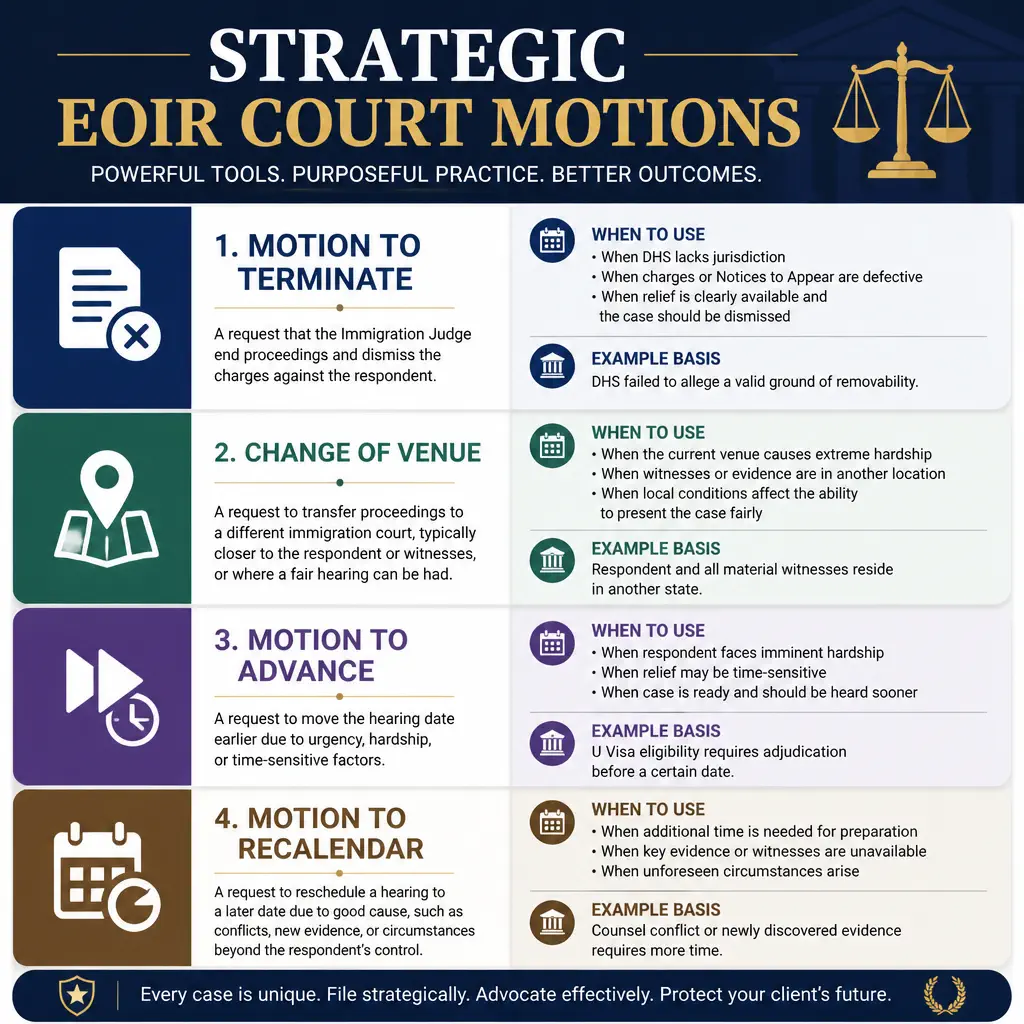
Motion to Terminate (MTT)

A Motion to Terminate asks the Immigration Judge to dismiss removal proceedings entirely. Common grounds for termination include:

  • Defective Notices to Appear (NTAs) that lack statutory time, date, or location details pursuant to governing Supreme Court precedent (e.g., Pereira v. Sessions and Niz-Chavez v. Garland).
  • Failure of the Department of Homeland Security (DHS) to establish alienage or deportability as charged.
  • Respondent’s acquisition or derivation of U.S. citizenship.

Change of Venue (COV)

If you were detained at the border or relocated to Texas after your court proceedings were initiated in another state, you must request a Change of Venue. A written Motion for Change of Venue asks the court to transfer your case file to the Immigration Court having jurisdiction over your new residence (such as the San Antonio or Houston Immigration Court).

Motion to Advance on the Calendar (MTAC)

Immigration Court dockets are frequently backlogged by several years. A Motion to Advance requests an earlier Individual Merits Hearing date based on urgent humanitarian circumstances, severe medical conditions, derivative family members aging out of eligibility, or key witness availability.

Motion to Recalendar (MTRecalendar)

If your removal case was previously placed on administrative closure, a Motion to Recalendar requests that the case be restored to the active court docket. This motion is typically utilized when an underlying affirmative application filed with USCIS (such as a U Visa or I-601A waiver) receives approval, allowing the court to grant final relief.

Written Oppositions & Responses to DHS Motions

DHS Trial Attorneys regularly file motions to admit government evidence, pre-remand claims, or push for summary deportation orders. Ponce Law Firm, PLLC prepares written oppositions to challenge government evidence, preserve evidentiary objections, and protect client due process rights.

Navigating the Stages of EOIR Removal Proceedings

Removal proceedings follow a structured judicial timeline before the Immigration Court:

  1. Service of Notice to Appear (NTA): DHS issues an NTA detailing the statutory charges of deportability or inadmissibility and files it with the EOIR court.
  2. Master Calendar Hearing (MCH): A preliminary hearing where the respondent enters pleadings to the charges, designates a country of removal, and asserts intended forms of relief (e.g., Cancellation, Asylum, or Adjustment).
  3. Evidentiary Motion & Written Filings: Counsel submits formal applications, supporting evidence, witness lists, country conditions reports, and legal briefs according to strict EOIR Practice Manual deadlines.
  4. Individual Merits Hearing: A full trial where testimony is taken, witnesses are cross-examined by the DHS Trial Attorney, evidence is reviewed, and the Immigration Judge renders a decision.
  5. Post-Hearing Orders or Appeals: If relief is granted, status is conferred; if relief is denied, the case transitions to appellate review before the Board of Immigration Appeals (BIA).

Why Choose Ponce Law Firm, PLLC for Deportation Defense?

When your life in the United States is threatened by deportation, you need representation that combines trial experience with unyielding dedication.

  • Two Decades of Trial & Courtroom Leadership: Lead Attorney Griselda Ponce has litigated complex immigration and removal cases for over 20 years.
  • Fifth Circuit Court of Appeals Admission: Admitted to practice before the U.S. Court of Appeals for the Fifth Circuit, Attorney Ponce understands how federal appellate precedent impacts trial tactics in Texas immigration courts.
  • Tough, No-Nonsense Representation: We do not sugarcoat the reality of removal proceedings. We deliver straightforward advice, build concrete evidentiary records, and fight aggressively in court.
  • 100% Bilingual Defense Team: Communication is crucial when preparing court testimony. Our team provides legal service in both English and Spanish.
  • Deep Local and National Community Commitment: Attorney Ponce’s historic federal court testimony regarding family detention conditions reflects our firm’s core commitment to protecting the immigrant community.

Frequently Ask Questions

Yes. You have the legal right to appeal an adverse decision to the Board of Immigration Appeals (BIA). A Notice of Appeal (Form EOIR-26) must be filed within 30 calendar days of the judge’s decision. Filing a timely appeal automatically stays execution of the removal order while the appeal is pending.

A Master Calendar Hearing is a short procedural hearing where the judge manages calendar scheduling, accepts legal pleadings, and sets deadlines. An Individual Merits Hearing is your actual trial. It is dedicated entirely to your case, lasting several hours, where you present live testimony, call witnesses, submit documentary evidence, and argue your defense against deportation.

Many noncitizens detained by ICE are eligible to request an Immigration Court Bond Hearing under INA § 236(a). To secure a bond, you must prove to the Immigration Judge that you are not a threat to public safety or national security and that you do not pose a flight risk. Individuals subject to mandatory detention under INA § 236(c) due to specific criminal records are ineligible for bond.

Do not ignore an NTA. Failing to appear for a scheduled Immigration Court hearing will result in an automatic in absentia order of removal, making you subject to immediate deportation and a 10-year bar to re-entry. Contact an experienced removal defense lawyer immediately to review the charges and begin preparing your strategy.

Legal & Information Disclaimer:

The information provided on this website and within our practice area articles is for general informational and educational purposes only. Immigration laws, regulations, processing timeframes, and government fees change frequently. While we strive to keep our content accurate and up to date, the information presented may not reflect the most current legal developments or official processing timelines.

Reading this content does not constitute formal legal advice or create an attorney-client relationship with Ponce Law Firm, PLLC. Before taking action or making decisions regarding your case, we strongly recommend checking official government websites—such as USCIS.gov—for the latest updates and consulting directly with a qualified immigration attorney to evaluate your individual circumstances.

Deportation & Removal Defense

Removal Defense & EOIR Immigration Court Lawyers in Austin, TX

Fighting to Protect Your Family, Freedom, and Right to Remain in the U.S.

Receiving a Notice to Appear (NTA) in Immigration Court or discovering that a loved one has been detained by Immigration and Customs Enforcement (ICE) is one of the most frightening experiences a family can face. The Executive Office for Immigration Review (EOIR) process is complex, high-stakes, and unyielding. One procedural error, missed deadline, or ineffective hearing can result in a final order of removal and separation from your home and family. At Ponce Law Firm, PLLC, we do not run from tough courtroom fights. Led by Lead Attorney Griselda Ponce—an experienced trial advocate licensed in Texas since 2004 and admitted to practice before the U.S. Court of Appeals for the Fifth Circuit—our firm specializes in complex removal defense and litigation. Based in Austin, Texas, and representing clients in Immigration Courts across Texas and nationwide, we bring a tough, candid, and direct legal defense to every case.

We do not make false promises or beat around the bush. We analyze the government’s charges, identify every available defense under federal law, challenge procedural defects, and aggressively advocate for your right to remain in the United States.

Overview of Removal Defenses & EOIR Court Motions

Relief / Motion CategoryPrimary Statutory Form / ToolLegal Standard & Primary PurposeKey Eligibility Considerations
Cancellation of Removal (42B)Form EOIR-42BNon-permanent resident defense against deportation10 years continuous presence, good moral character, exceptional & extremely unusual hardship to qualifying U.S. citizen/LPR relative
Asylum, Withholding & CATForm I-589Protection based on fear of persecution or torture in home countryPast persecution or well-founded fear based on race, religion, nationality, PSG, or political opinion; 1-year deadline exceptions
Adjustment of Status in CourtForm I-485Securing permanent residency directly before an Immigration JudgeApproved underlying petition (I-130/I-360) and immediately available immigrant visa
Motion to Terminate (MTT)Written EOIR MotionDismissing removal proceedings due to defective charges or NTAInvalid Notice to Appear, lack of alienage proof, or statutory grounds not met
Change of Venue (COV)Written EOIR MotionTransferring case to a new Immigration Court locationProof of new permanent residence and geographic convenience
Motion to RecalendarWritten EOIR MotionRestoring an administratively closed case to the active docketApproved affirmative petition (e.g., U Visa or waiver) ready for final court review

Key Substantive Defenses Against Removal

When placed in removal proceedings, noncitizens have the constitutional right to due process and the opportunity to apply for statutory forms of relief under the Immigration and Nationality Act (INA).

1. Cancellation of Removal for Non-Permanent Residents (Form EOIR-42B)

Cancellation of Removal is one of the most powerful defenses available to non-permanent residents who are facing deportation. If granted by an Immigration Judge, the removal proceedings are terminated, and the respondent is granted Lawful Permanent Resident (Green Card) status.

Statutory Requirements under INA § 240A(b):

To qualify for 42B Cancellation of Removal, an applicant must satisfy four strict statutory criteria:

  1. 10 Years of Continuous Physical Presence: You must prove continuous physical presence in the United States for at least 10 years immediately preceding the service of the Notice to Appear (NTA) or the commission of a disqualifying offense (known as the “stop-time rule”).
  2. Good Moral Character (GMC): You must demonstrate good moral character throughout the entire 10-year period.
  3. No Disqualifying Criminal Convictions: You must not have been convicted of an offense under INA § 212(a)(2), 237(a)(2), or 237(a)(3) (such as crimes involving moral turpitude, drug offenses, or aggravated felonies).
  4. Exceptional and Extremely Unusual Hardship: You must establish that your removal would result in exceptional and extremely unusual hardship to your qualifying U.S. citizen or Lawful Permanent Resident spouse, parent, or child.

Proving “exceptional and extremely unusual hardship” requires establishing that the hardship to your qualifying family member goes far beyond the normal distress associated with deportation. Ponce Law Firm, PLLC builds exhaustive evidentiary records—incorporating medical reports, psychological evaluations, school records, and financial analyses—to establish this high standard before the court.

2. Asylum, Withholding of Removal, and CAT Protection (Form I-589)

Individuals fleeing persecution, violence, or torture in their home countries can apply for protection in removal proceedings by submitting Form I-589.

  • Asylum (INA § 208): Provides protection for individuals who have suffered past persecution or have a well-founded fear of future persecution based on race, religion, nationality, membership in a particular social group (PSG), or political opinion. Asylum offers a direct path to a Green Card. Applications must generally be filed within one year of arriving in the U.S., unless extraordinary circumstances or changed country conditions apply.
  • Withholding of Removal (INA § 241(b)(3)): A mandatory form of relief for individuals who establish that it is “more likely than not” (greater than a 50% chance) their life or freedom would be threatened on account of a protected ground. While Withholding prevents deportation to that specific country, it does not lead to a Green Card.
  • Convention Against Torture (CAT): Prevents removal to a country where it is more likely than not that the individual would be subjected to severe pain or suffering (torture) inflicted by, or with the acquiescence of, a public official.

3. Adjustment of Status in Immigration Court (Form I-485)

If a respondent in removal proceedings is the beneficiary of an approved family petition (Form I-130) or humanitarian self-petition (such as VAWA Form I-360), and an immigrant visa is immediately available, jurisdiction to grant permanent residence shifts to the Immigration Judge.

During proceedings, our attorneys present Form I-485 alongside supporting financial affidavits (Form I-864), medical examinations, and evidence of admissibility to request that the Immigration Judge grant Green Card status and dismiss removal proceedings.

4. Managing Pending Applications in Removal Proceedings

When you have a pending affirmative petition before USCIS—such as an active U Visa (Form I-918), T Visa (Form I-914), or I-130 petition—while simultaneously defending against deportation in court, strategic coordination is required.

Ponce Law Firm, PLLC manages the dual-track strategy between USCIS and EOIR, seeking court continuances, administrative closures, or stays of removal while USCIS completes adjudication of your primary petition.

Strategic Procedural Motions in EOIR Practice

In addition to substantive claims for relief, removal defense relies heavily on aggressive written motion practice. A timely, well-argued motion can alter the direction of a case, secure a change of location, or result in complete termination of proceedings.

Motion to Terminate (MTT)

A Motion to Terminate asks the Immigration Judge to dismiss removal proceedings entirely. Common grounds for termination include:

  • Defective Notices to Appear (NTAs) that lack statutory time, date, or location details pursuant to governing Supreme Court precedent (e.g., Pereira v. Sessions and Niz-Chavez v. Garland).
  • Failure of the Department of Homeland Security (DHS) to establish alienage or deportability as charged.
  • Respondent’s acquisition or derivation of U.S. citizenship.

Change of Venue (COV)

If you were detained at the border or relocated to Texas after your court proceedings were initiated in another state, you must request a Change of Venue. A written Motion for Change of Venue asks the court to transfer your case file to the Immigration Court having jurisdiction over your new residence (such as the San Antonio or Houston Immigration Court).

Motion to Advance on the Calendar (MTAC)

Immigration Court dockets are frequently backlogged by several years. A Motion to Advance requests an earlier Individual Merits Hearing date based on urgent humanitarian circumstances, severe medical conditions, derivative family members aging out of eligibility, or key witness availability.

Motion to Recalendar (MTRecalendar)

If your removal case was previously placed on administrative closure, a Motion to Recalendar requests that the case be restored to the active court docket. This motion is typically utilized when an underlying affirmative application filed with USCIS (such as a U Visa or I-601A waiver) receives approval, allowing the court to grant final relief.

Written Oppositions & Responses to DHS Motions

DHS Trial Attorneys regularly file motions to admit government evidence, pre-remand claims, or push for summary deportation orders. Ponce Law Firm, PLLC prepares written oppositions to challenge government evidence, preserve evidentiary objections, and protect client due process rights.

Navigating the Stages of EOIR Removal Proceedings

Removal proceedings follow a structured judicial timeline before the Immigration Court:

  1. Service of Notice to Appear (NTA): DHS issues an NTA detailing the statutory charges of deportability or inadmissibility and files it with the EOIR court.
  2. Master Calendar Hearing (MCH): A preliminary hearing where the respondent enters pleadings to the charges, designates a country of removal, and asserts intended forms of relief (e.g., Cancellation, Asylum, or Adjustment).
  3. Evidentiary Motion & Written Filings: Counsel submits formal applications, supporting evidence, witness lists, country conditions reports, and legal briefs according to strict EOIR Practice Manual deadlines.
  4. Individual Merits Hearing: A full trial where testimony is taken, witnesses are cross-examined by the DHS Trial Attorney, evidence is reviewed, and the Immigration Judge renders a decision.
  5. Post-Hearing Orders or Appeals: If relief is granted, status is conferred; if relief is denied, the case transitions to appellate review before the Board of Immigration Appeals (BIA).

Why Choose Ponce Law Firm, PLLC for Deportation Defense?

When your life in the United States is threatened by deportation, you need representation that combines trial experience with unyielding dedication.

  • Two Decades of Trial & Courtroom Leadership: Lead Attorney Griselda Ponce has litigated complex immigration and removal cases for over 20 years.
  • Fifth Circuit Court of Appeals Admission: Admitted to practice before the U.S. Court of Appeals for the Fifth Circuit, Attorney Ponce understands how federal appellate precedent impacts trial tactics in Texas immigration courts.
  • Tough, No-Nonsense Representation: We do not sugarcoat the reality of removal proceedings. We deliver straightforward advice, build concrete evidentiary records, and fight aggressively in court.
  • 100% Bilingual Defense Team: Communication is crucial when preparing court testimony. Our team provides legal service in both English and Spanish.
  • Deep Local and National Community Commitment: Attorney Ponce’s historic federal court testimony regarding family detention conditions reflects our firm’s core commitment to protecting the immigrant community.