

Opens in a new tab
Current Situation

The following questions are optional

Disclaimer & Privacy Notice

Discreet & Secure Consultation Request: We treat your inquiry with strict privacy and professional discretion. Provide your basic details, and our legal team will contact you securely to discuss your case. Disclaimer & Privacy Notice: Submitting this form does not create an attorney-client relationship. While we maintain strict privacy regarding all inquiries and will never sell or share your data, please do not submit sensitive case documents or time-sensitive details through this web form. Full case evaluation and confidential document review take place during your private consultation. You may opt out of communications at any time.

Google reCaptcha: Invalid site key.

Ponce Law Firm
Schedule Now
1212 E. Braker Ln
Austin, TX 78753
1212 E. Braker Ln, Austin, TX 78753
Ponce Law Firm, PLLC | Immigration & Naturalization
Proudly serving the immigrant community in Texas.

Notice of Appeal or Motion

Current Situation

The following questions are optional

Discreet & Secure Consultation Request: We treat your inquiry with strict privacy and professional discretion. Provide your basic details, and our legal team will contact you securely to discuss your case. Disclaimer & Privacy Notice: Submitting this form does not create an attorney-client relationship. While we maintain strict privacy regarding all inquiries and will never sell or share your data, please do not submit sensitive case documents or time-sensitive details through this web form. Full case evaluation and confidential document review take place during your private consultation. You may opt out of communications at any time.

Google reCaptcha: Invalid site key.

Post-Order Motions & Immigration Appeals Lawyers in Austin, TX

An Adverse Decision Is Not Always the End of Your Case

Receiving a deportation or removal order from an Immigration Judge, or having a critical immigration petition denied, can feel like a devastating blow. For many individuals and families, an adverse ruling brings immediate fear of separation, uncertainty, and exile from the place they call home.

However, under federal immigration law, a judge’s removal order or administrative denial does not automatically mean you have run out of options. The U.S. legal system provides specific administrative and judicial mechanisms—including Motions to Reopen (MTR), Motions to Reconsider, and Appeals to the Board of Immigration Appeals (BIA)—to correct legal errors, present vital new evidence, or challenge unconstitutional procedures.

At Ponce Law Firm, PLLC, we specialize in high-stakes appellate litigation and post-order motion practice. Led by Lead Attorney Griselda Ponce—an experienced trial advocate admitted to the State Bar of Texas in 2004 and the U.S. Court of Appeals for the Fifth Circuit—our firm takes on complex immigration appeals and post-order challenges across Texas and nationwide.

We approach post-order defense with complete candor and rigorous legal analysis. We do not make empty promises. Our team thoroughly reviews court transcripts and the complete administrative record, identifies procedural and judicial errors, and crafts compelling motions and appellate briefs to challenge removal and fight for your future in the United States.

Overview of Post-Order Motions & Appeals

Remedy CategoryPrimary Statutory AuthorityFiling Deadline / Time LimitPrimary Legal Basis & Standard
Motion to Reopen (Exceptional Circumstances)INA § 240(c)(7) / 8 C.F.R. § 1003.23Generally 90 days from final orderNew, material facts or evidence that was not previously available
Motion to Reopen (Lack of Notice)INA § 240(b)(5)(C)No deadline (can be filed anytime)Rescinding an in absentia order due to lack of statutory notice
Motion to ReconsiderINA § 240(c)(6) / 8 C.F.R. § 1003.2330 calendar days from final orderErrors of law or fact in the judge’s original decision
BIA Appeal (Form EOIR-26)8 C.F.R. § 1003.3830 calendar days from judge’s rulingAdministrative review of judicial error, statutory misapplication, or abuse of discretion
Fifth Circuit Petition for ReviewINA § 24230 calendar days from final BIA orderFederal judicial review of BIA legal errors and constitutional violations

1. Motions to Reopen Based on Exceptional Circumstances (MTR Ex. Cir.)

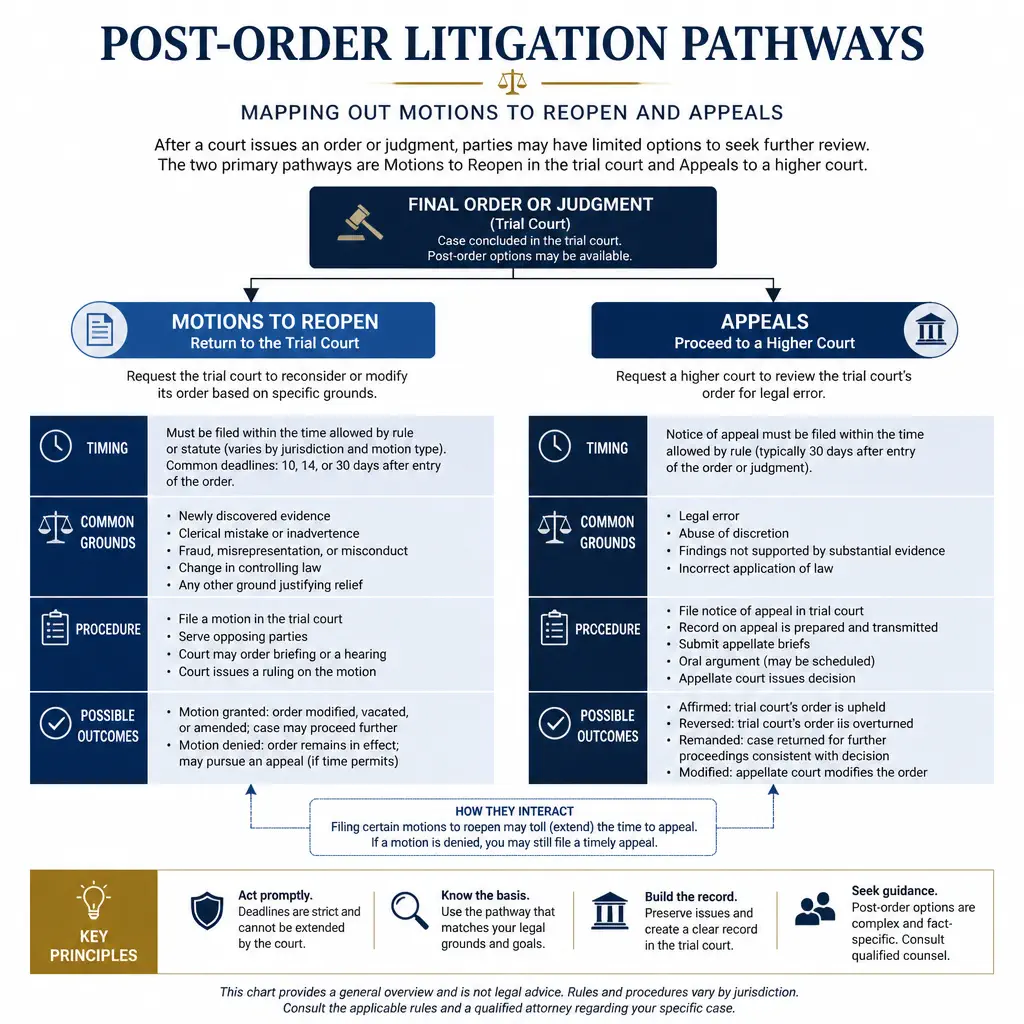
A Motion to Reopen (MTR) requests that the Immigration Judge or the Board of Immigration Appeals re-examine a completed case to evaluate new evidence or changed circumstances that were not available during the original proceedings.
The 90-Day Rule and Evidentiary Requirements

Under INA § 240(c)(7), a party is generally limited to filing one Motion to Reopen, which must be submitted within 90 days of the entry of a final administrative order of removal.

To succeed, an MTR based on exceptional circumstances must present evidence that is:

  • New: The facts or evidence did not exist or were not available at the time of the previous hearing.
  • Material: The new evidence is significant enough that it would likely change the outcome of the case.
  • Supported by Documentation: Assertions must be supported by sworn affidavits, medical records, official certificates, or country condition reports.

Recognizing Statutory Exceptions to the 90-Day Deadline

In specific situations, federal law permits filing a Motion to Reopen beyond the standard 90-day window:

  • Changed Country Conditions: Applicants seeking asylum, withholding of removal, or CAT protection can file an MTR at any time if country conditions in their home nation have materially deteriorated.
  • Ineffective Assistance of Counsel (Equitable Tolling): If a prior attorney or non-attorney “notario” committed severe malpractice or fraud that prevented you from presenting your case, the 90-day deadline may be equitably tolled (paused) under the procedural standards established in Matter of Lozada.
  • Joint Motions with DHS: If the Department of Homeland Security (DHS) Trial Attorney agrees to join in the motion, an MTR can be submitted at any time without time or numerical limitations.

2. Motions to Reopen for Lack of Notice (MTR No Notice – In Absentia Orders)

If a foreign national fails to appear for a scheduled Immigration Court hearing, the Immigration Judge is required by law to enter an in absentia order of removal in their absence. An in absentia order carries severe consequences, including an immediate 10-year bar to discretionary immigration relief.

Rescinding an In Absentia Order (INA § 240(b)(5)(C))

A deportation order issued in your absence can be reopened and set aside by filing a specialized Motion to Reopen to Rescind an In Absentia Order.

Under federal law, there are two primary grounds to rescind an in absentia order:

  1. Lack of Proper Statutory Notice: You did not receive proper statutory notice of the hearing date, time, or location as required by law. A Motion to Reopen based on lack of notice can be filed at ANY time—even years or decades after the order was entered.
  2. Exceptional Circumstances for Failure to Appear: You failed to appear due to extreme, unforeseen circumstances beyond your control, such as sudden hospitalization, severe illness, or the death of an immediate family member. (MTRs based on exceptional circumstances for missing court must be filed within 180 days of the order).

Address Compliance & Defective Notices to Appear

Many in absentia orders occur because court notices were mailed to an old address or lost in transmission. If you updated your address using Form EOIR-33 and the court mailed the notice to the wrong address, or if the original Notice to Appear (NTA) failed to specify the required statutory details, Ponce Law Firm, PLLC prepares aggressive motions to rescind the order and reopen your case.

3. Motions to Reconsider (MTReconsider)

Unlike a Motion to Reopen—which relies on new facts or evidence—a Motion to Reconsider asserts that the Immigration Judge or Board of Immigration Appeals made an error of law or fact in their original decision based on the existing record.

Key Rules for Motions to Reconsider:

  • Strict 30-Day Window: A Motion to Reconsider must be filed within 30 calendar days of the date of the final administrative decision.
  • Identifying Legal Errors: The motion must specify the particular errors of law or fact in the prior decision, supported by statutory citations, relevant case precedents, and references to the court transcript.
  • Numerical Limit: A party is generally limited to filing one Motion to Reconsider in any removal proceeding.

Ponce Law Firm, PLLC conducts exhaustive reviews of judicial rulings to identify misapplications of Fifth Circuit precedent or statutory interpretation, structuring precise Motions to Reconsider to correct judicial mistakes.

4. Appeals to the Board of Immigration Appeals (BIA Appeal – Form EOIR-26)

The Board of Immigration Appeals (BIA), located in Falls Church, Virginia, is the highest administrative tribunal for interpreting and applying U.S. immigration law. If an Immigration Judge issues an adverse ruling at your Individual Merits Hearing, you have the statutory right to appeal that decision to the BIA.
The Strict 30-Day BIA Appeal Deadline

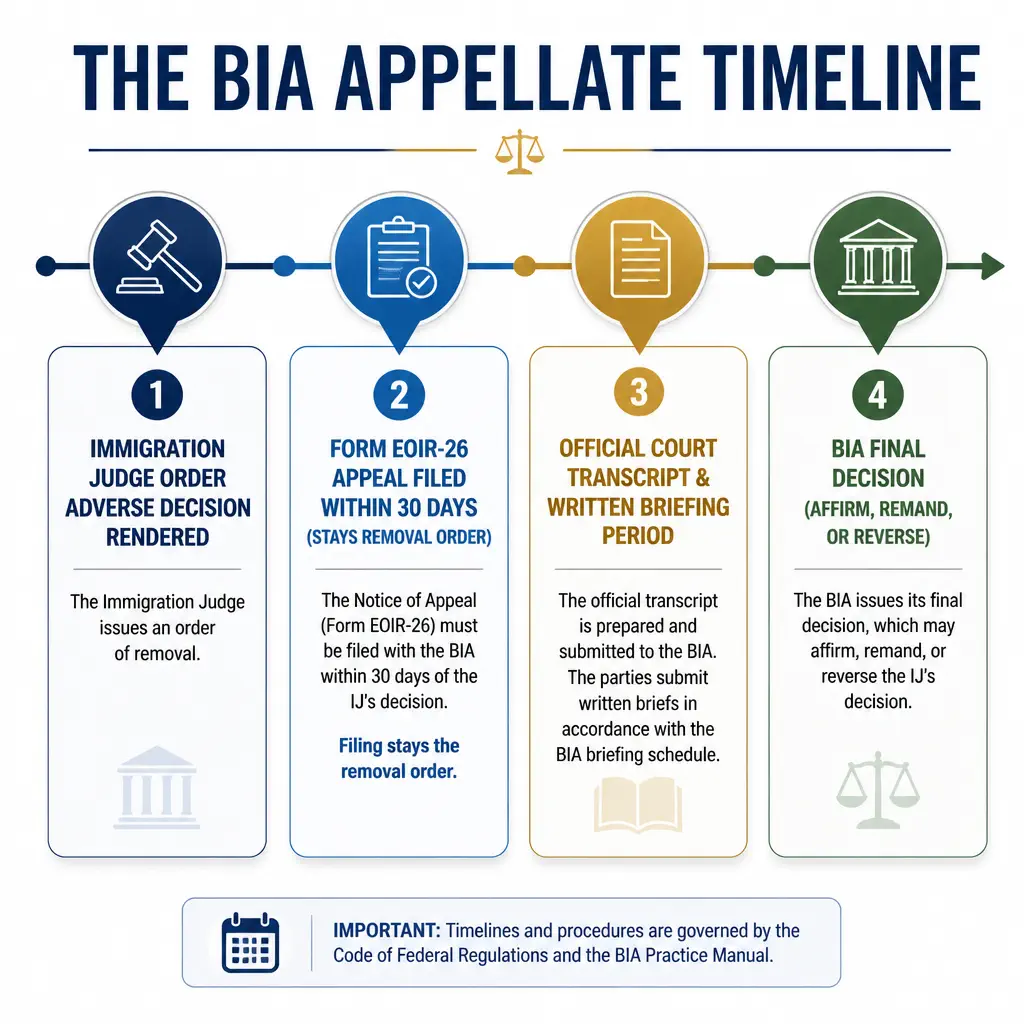
To appeal an Immigration Judge’s decision, you must file Form EOIR-26 (Notice of Appeal from a Decision of an Immigration Judge) with the BIA within 30 calendar days of the judge’s oral or written decision.

  • Crucial Rule: The 30-day deadline is a receipt deadline, not a postmark deadline. Form EOIR-26 must physically arrive at the BIA clerk’s office on or before the 30th day. Missing this deadline by even a single day will result in summary dismissal of your appeal, making the removal order final.

Automatic Stay of Removal

Filing a timely BIA appeal secures an automatic stay of removal while your appeal is pending before the Board. This prevents ICE from deporting you while the appellate judges review your case file.

The Written Briefing Process

Once the BIA processes Form EOIR-26, it prepares the official transcript of your trial hearings and issues a written Briefing Schedule. Both your attorney and the government Trial Attorney are given 21 days (with the possibility of one extension) to submit formal written legal briefs.

Appellate brief writing is highly specialized. Attorney Griselda Ponce synthesizes trial records, challenges evidentiary rulings, points out procedural violations, and applies binding Fifth Circuit precedent to argue for reversal or a remand back to the Immigration Court.

5. Federal Judicial Review: U.S. Court of Appeals for the Fifth Circuit

If the Board of Immigration Appeals dismisses your appeal, administrative remedies within EOIR are exhausted. However, judicial review remains available in federal court by filing a Petition for Review with the U.S. Court of Appeals for the Fifth Circuit (which holds federal appellate jurisdiction over Texas immigration cases).

A Petition for Review must be filed within 30 calendar days of the final BIA order. Unlike BIA appeals, filing a federal Petition for Review does not automatically stay your deportation; a separate Motion for Stay of Removal must be filed directly with the Fifth Circuit.

Lead Attorney Griselda Ponce is admitted to practice before the Fifth Circuit Court of Appeals, bringing direct federal appellate litigation experience to protect our clients at the highest judicial levels.

Why Choose Ponce Law Firm, PLLC for Appeals & Motions?

Post-order litigation demands technical legal precision, deep knowledge of procedural rules, and uncompromising advocacy.

  • Admitted to the Fifth Circuit Court of Appeals: Lead Attorney Griselda Ponce has litigated complex immigration issues for over two decades and holds admission to federal appellate practice.
  • Tough, No-Nonsense Case Evaluation: Appeals and motions are driven by law and precedent, not wishful thinking. We conduct candid legal audits of your court transcripts to give you an honest assessment of your chances.
  • Meticulous Trial Record Analysis: Winning a Motion to Reopen or BIA appeal requires identifying subtle errors in court transcripts and evidentiary submissions. We analyze every line of your record.
  • 100% Bilingual Legal Practice: Our staff provides direct legal guidance in English and Spanish, keeping you and your family fully informed throughout the appellate process.

Frequently Ask Questions

If your prior lawyer missed mandatory court deadlines, failed to submit required applications, or provided inadequate legal representation, you may be eligible to file a Motion to Reopen based on Ineffective Assistance of Counsel. This process requires complying with procedural steps under Matter of Lozada, including notifying prior counsel and filing appropriate bar complaints when warranted.

A BIA Appeal challenges a decision made by an Immigration Judge based on errors of law or fact using the existing trial record and must be filed within 30 days. A Motion to Reopen introduces brand new facts, evidence, or relief claims that were not part of the original court record.

Yes, under specific legal grounds. If your deportation order was issued in absentia because you never received statutory notice of your hearing, you can file a Motion to Reopen at any time without a deadline. Additionally, cases can be reopened beyond normal deadlines if you qualify for equitable tolling due to ineffective assistance of prior counsel or if country conditions in your home nation have worsened significantly.

No. Unlike a timely BIA appeal (Form EOIR-26), filing a Motion to Reopen with an Immigration Judge does not automatically stay execution of a removal order, unless the motion is based on lack of notice (in absentia order) or filed jointly with DHS. In all other MTR cases, an explicit Emergency Motion for Stay of Removal must be submitted to the court or ICE to prevent deportation while the motion is under review.

Legal & Information Disclaimer:

The information provided on this website and within our practice area articles is for general informational and educational purposes only. Immigration laws, regulations, processing timeframes, and government fees change frequently. While we strive to keep our content accurate and up to date, the information presented may not reflect the most current legal developments or official processing timelines.

Reading this content does not constitute formal legal advice or create an attorney-client relationship with Ponce Law Firm, PLLC. Before taking action or making decisions regarding your case, we strongly recommend checking official government websites—such as USCIS.gov—for the latest updates and consulting directly with a qualified immigration attorney to evaluate your individual circumstances.

Notice of Appeal or Motion

Post-Order Motions & Immigration Appeals Lawyers in Austin, TX

An Adverse Decision Is Not Always the End of Your Case

Receiving a deportation or removal order from an Immigration Judge, or having a critical immigration petition denied, can feel like a devastating blow. For many individuals and families, an adverse ruling brings immediate fear of separation, uncertainty, and exile from the place they call home.

However, under federal immigration law, a judge’s removal order or administrative denial does not automatically mean you have run out of options. The U.S. legal system provides specific administrative and judicial mechanisms—including Motions to Reopen (MTR), Motions to Reconsider, and Appeals to the Board of Immigration Appeals (BIA)—to correct legal errors, present vital new evidence, or challenge unconstitutional procedures.

At Ponce Law Firm, PLLC, we specialize in high-stakes appellate litigation and post-order motion practice. Led by Lead Attorney Griselda Ponce—an experienced trial advocate admitted to the State Bar of Texas in 2004 and the U.S. Court of Appeals for the Fifth Circuit—our firm takes on complex immigration appeals and post-order challenges across Texas and nationwide.

We approach post-order defense with complete candor and rigorous legal analysis. We do not make empty promises. Our team thoroughly reviews court transcripts and the complete administrative record, identifies procedural and judicial errors, and crafts compelling motions and appellate briefs to challenge removal and fight for your future in the United States.

Overview of Post-Order Motions & Appeals

Remedy CategoryPrimary Statutory AuthorityFiling Deadline / Time LimitPrimary Legal Basis & Standard
Motion to Reopen (Exceptional Circumstances)INA § 240(c)(7) / 8 C.F.R. § 1003.23Generally 90 days from final orderNew, material facts or evidence that was not previously available
Motion to Reopen (Lack of Notice)INA § 240(b)(5)(C)No deadline (can be filed anytime)Rescinding an in absentia order due to lack of statutory notice
Motion to ReconsiderINA § 240(c)(6) / 8 C.F.R. § 1003.2330 calendar days from final orderErrors of law or fact in the judge’s original decision
BIA Appeal (Form EOIR-26)8 C.F.R. § 1003.3830 calendar days from judge’s rulingAdministrative review of judicial error, statutory misapplication, or abuse of discretion
Fifth Circuit Petition for ReviewINA § 24230 calendar days from final BIA orderFederal judicial review of BIA legal errors and constitutional violations

1. Motions to Reopen Based on Exceptional Circumstances (MTR Ex. Cir.)

A Motion to Reopen (MTR) requests that the Immigration Judge or the Board of Immigration Appeals re-examine a completed case to evaluate new evidence or changed circumstances that were not available during the original proceedings.

The 90-Day Rule and Evidentiary Requirements

Under INA § 240(c)(7), a party is generally limited to filing one Motion to Reopen, which must be submitted within 90 days of the entry of a final administrative order of removal.

To succeed, an MTR based on exceptional circumstances must present evidence that is:

  • New: The facts or evidence did not exist or were not available at the time of the previous hearing.
  • Material: The new evidence is significant enough that it would likely change the outcome of the case.
  • Supported by Documentation: Assertions must be supported by sworn affidavits, medical records, official certificates, or country condition reports.

Recognizing Statutory Exceptions to the 90-Day Deadline

In specific situations, federal law permits filing a Motion to Reopen beyond the standard 90-day window:

  • Changed Country Conditions: Applicants seeking asylum, withholding of removal, or CAT protection can file an MTR at any time if country conditions in their home nation have materially deteriorated.
  • Ineffective Assistance of Counsel (Equitable Tolling): If a prior attorney or non-attorney “notario” committed severe malpractice or fraud that prevented you from presenting your case, the 90-day deadline may be equitably tolled (paused) under the procedural standards established in Matter of Lozada.
  • Joint Motions with DHS: If the Department of Homeland Security (DHS) Trial Attorney agrees to join in the motion, an MTR can be submitted at any time without time or numerical limitations.

2. Motions to Reopen for Lack of Notice (MTR No Notice – In Absentia Orders)

If a foreign national fails to appear for a scheduled Immigration Court hearing, the Immigration Judge is required by law to enter an in absentia order of removal in their absence. An in absentia order carries severe consequences, including an immediate 10-year bar to discretionary immigration relief.

Rescinding an In Absentia Order (INA § 240(b)(5)(C))

A deportation order issued in your absence can be reopened and set aside by filing a specialized Motion to Reopen to Rescind an In Absentia Order.

Under federal law, there are two primary grounds to rescind an in absentia order:

  1. Lack of Proper Statutory Notice: You did not receive proper statutory notice of the hearing date, time, or location as required by law. A Motion to Reopen based on lack of notice can be filed at ANY time—even years or decades after the order was entered.
  2. Exceptional Circumstances for Failure to Appear: You failed to appear due to extreme, unforeseen circumstances beyond your control, such as sudden hospitalization, severe illness, or the death of an immediate family member. (MTRs based on exceptional circumstances for missing court must be filed within 180 days of the order).

Address Compliance & Defective Notices to Appear

Many in absentia orders occur because court notices were mailed to an old address or lost in transmission. If you updated your address using Form EOIR-33 and the court mailed the notice to the wrong address, or if the original Notice to Appear (NTA) failed to specify the required statutory details, Ponce Law Firm, PLLC prepares aggressive motions to rescind the order and reopen your case.

3. Motions to Reconsider (MTReconsider)

Unlike a Motion to Reopen—which relies on new facts or evidence—a Motion to Reconsider asserts that the Immigration Judge or Board of Immigration Appeals made an error of law or fact in their original decision based on the existing record.

Key Rules for Motions to Reconsider:

  • Strict 30-Day Window: A Motion to Reconsider must be filed within 30 calendar days of the date of the final administrative decision.
  • Identifying Legal Errors: The motion must specify the particular errors of law or fact in the prior decision, supported by statutory citations, relevant case precedents, and references to the court transcript.
  • Numerical Limit: A party is generally limited to filing one Motion to Reconsider in any removal proceeding.

Ponce Law Firm, PLLC conducts exhaustive reviews of judicial rulings to identify misapplications of Fifth Circuit precedent or statutory interpretation, structuring precise Motions to Reconsider to correct judicial mistakes.

4. Appeals to the Board of Immigration Appeals (BIA Appeal – Form EOIR-26)

The Board of Immigration Appeals (BIA), located in Falls Church, Virginia, is the highest administrative tribunal for interpreting and applying U.S. immigration law. If an Immigration Judge issues an adverse ruling at your Individual Merits Hearing, you have the statutory right to appeal that decision to the BIA.

The Strict 30-Day BIA Appeal Deadline

To appeal an Immigration Judge’s decision, you must file Form EOIR-26 (Notice of Appeal from a Decision of an Immigration Judge) with the BIA within 30 calendar days of the judge’s oral or written decision.

  • Crucial Rule: The 30-day deadline is a receipt deadline, not a postmark deadline. Form EOIR-26 must physically arrive at the BIA clerk’s office on or before the 30th day. Missing this deadline by even a single day will result in summary dismissal of your appeal, making the removal order final.

Automatic Stay of Removal

Filing a timely BIA appeal secures an automatic stay of removal while your appeal is pending before the Board. This prevents ICE from deporting you while the appellate judges review your case file.

The Written Briefing Process

Once the BIA processes Form EOIR-26, it prepares the official transcript of your trial hearings and issues a written Briefing Schedule. Both your attorney and the government Trial Attorney are given 21 days (with the possibility of one extension) to submit formal written legal briefs.

Appellate brief writing is highly specialized. Attorney Griselda Ponce synthesizes trial records, challenges evidentiary rulings, points out procedural violations, and applies binding Fifth Circuit precedent to argue for reversal or a remand back to the Immigration Court.

5. Federal Judicial Review: U.S. Court of Appeals for the Fifth Circuit

If the Board of Immigration Appeals dismisses your appeal, administrative remedies within EOIR are exhausted. However, judicial review remains available in federal court by filing a Petition for Review with the U.S. Court of Appeals for the Fifth Circuit (which holds federal appellate jurisdiction over Texas immigration cases).

A Petition for Review must be filed within 30 calendar days of the final BIA order. Unlike BIA appeals, filing a federal Petition for Review does not automatically stay your deportation; a separate Motion for Stay of Removal must be filed directly with the Fifth Circuit.

Lead Attorney Griselda Ponce is admitted to practice before the Fifth Circuit Court of Appeals, bringing direct federal appellate litigation experience to protect our clients at the highest judicial levels.

Why Choose Ponce Law Firm, PLLC for Appeals & Motions?

Post-order litigation demands technical legal precision, deep knowledge of procedural rules, and uncompromising advocacy.

  • Admitted to the Fifth Circuit Court of Appeals: Lead Attorney Griselda Ponce has litigated complex immigration issues for over two decades and holds admission to federal appellate practice.
  • Tough, No-Nonsense Case Evaluation: Appeals and motions are driven by law and precedent, not wishful thinking. We conduct candid legal audits of your court transcripts to give you an honest assessment of your chances.
  • Meticulous Trial Record Analysis: Winning a Motion to Reopen or BIA appeal requires identifying subtle errors in court transcripts and evidentiary submissions. We analyze every line of your record.
  • 100% Bilingual Legal Practice: Our staff provides direct legal guidance in English and Spanish, keeping you and your family fully informed throughout the appellate process.